


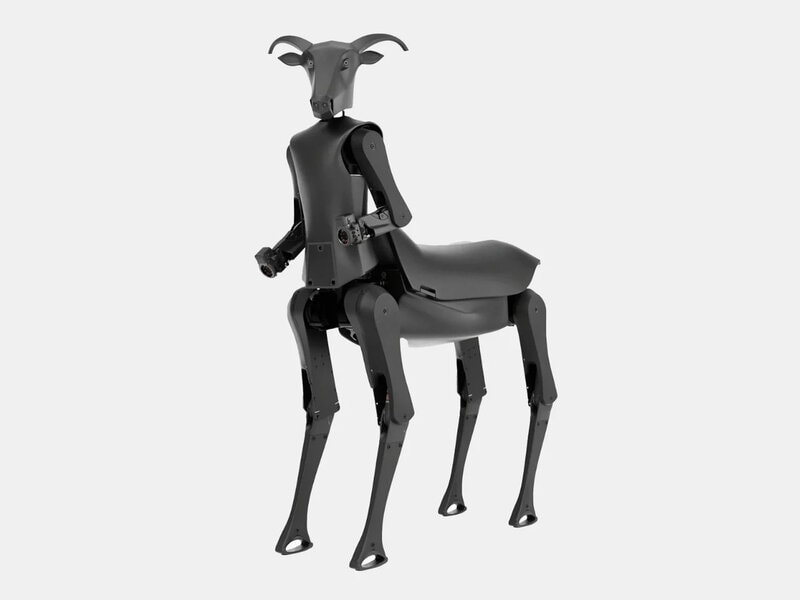



The Threehalves Robot Combines a Humanoid Upper Body with a Quadruped Base
The Threehalves robot is a prototype developed by California startup Satyress for dangerous environments where human workers face significant risk. Designed with a humanoid torso mounted on a four-legged base, the robot can operate conventional tools such as chainsaws and impact drivers while maintaining stability across uneven terrain. Its friction-braked joints require no power to remain stationary, improving efficiency during extended operations in locations including wildfire zones, disaster sites and other hazardous outdoor settings.
Rather than relying on fully autonomous operation, Threehalves is controlled remotely using a joystick interface that allows the onboard systems to manage balance while the operator focuses on movement and task execution. The unconventional centaur-like form prioritizes function over familiarity, sacrificing the ability to navigate narrow indoor spaces in favor of stability and utility in open environments.
Image Credit: Satyress
Rather than relying on fully autonomous operation, Threehalves is controlled remotely using a joystick interface that allows the onboard systems to manage balance while the operator focuses on movement and task execution. The unconventional centaur-like form prioritizes function over familiarity, sacrificing the ability to navigate narrow indoor spaces in favor of stability and utility in open environments.
Image Credit: Satyress
Consumer Demand Drives Foldable and Multi-Screen Devices
Consumers are adopting foldable and multi-screen devices as they seek more versatile and pocketable screen options for enhanced mobility and functionality.
Question 1
Which of the following types of devices have you personally used in the past 12 months?
Select up to 8
Question 2
What are the main reasons you use or chose this type of device?
Select up to 3
Question 3
How likely would you be to choose a foldable or multi-screen device the next time you purchase a smartphone, tablet, or laptop?
Trend Themes
-
Centaur Robotics — Hybrid humanoid-quadruped designs expand field robotics by combining tool-handling dexterity with terrain stability for hazardous outdoor work.
-
Remote Hazard Operations — Joystick-controlled robotic systems create new possibilities for keeping skilled workers out of wildfire zones, disaster areas and other high-risk environments.
-
Passive-efficiency Joints — Friction-braked joints that hold position without power point to longer-duration robotic deployments with reduced energy demands in remote locations.
Industry Implications
-
Emergency Response — Robots capable of using standard tools on unstable ground reshape disaster recovery by supporting safer search, clearing and repair tasks.
-
Wildfire Management — Rugged teleoperated machines introduce alternative approaches to firefighting support where heat, smoke and terrain limit human crews.
-
Construction Equipment — Tool-compatible robotic platforms suggest a shift toward adaptable machines that perform specialized tasks without requiring redesigned jobsite infrastructure.
9.3
Score
Popularity
Activity
Freshness