




Wallmakers Designed the Bridge House in Karjat with a Suspended Structure
Amy Duong — May 26, 2026 — Art & Design
References: wallmakers.org
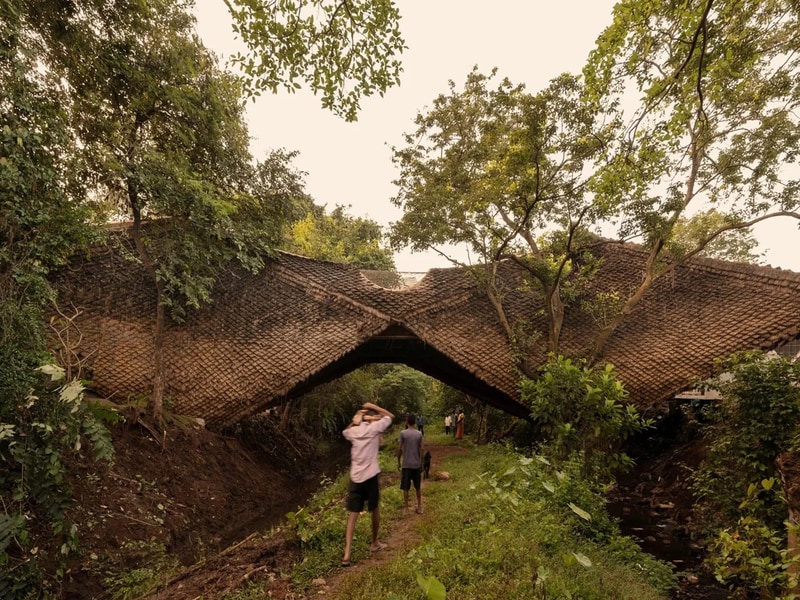
Wallmakers developed the Bridge House in Karjat, India, as a suspended residence spanning a seven-metre-deep gorge running through the site. Led by architect Vinu Daniel, the project uses the gorge itself as the structural foundation, allowing the house to bridge across the landscape instead of occupying one side of it. The exterior is wrapped in overlapping thatched panels that form a scale-like surface across the curved facade.
The residence combines a parabolic structural profile with elevated circulation paths positioned above the natural stream below. Wallmakers integrated stone, timber, thatch, and exposed structural elements throughout the project, while the suspended configuration minimizes excavation across the rural site. Interior spaces extend along the bridge-like footprint with openings positioned toward the surrounding landscape and gorge.
Image Credit: Wallmakers
The residence combines a parabolic structural profile with elevated circulation paths positioned above the natural stream below. Wallmakers integrated stone, timber, thatch, and exposed structural elements throughout the project, while the suspended configuration minimizes excavation across the rural site. Interior spaces extend along the bridge-like footprint with openings positioned toward the surrounding landscape and gorge.
Image Credit: Wallmakers
Trend Themes
-
Landscape-as-structure — By using the gorge as the primary load-bearing element, buildings can be reimagined to integrate topography as an intentional structural system enabling minimal excavation footprints.
-
Suspended Modular Architecture — Suspended bridge-like footprints suggest opportunities for prefabricated modules that cantilever across voids to create adaptable, transportable living sequences.
-
Textured Bio-based Facades — The use of overlapping thatch and natural cladding points toward facade systems that combine vernacular materials with engineered layering for thermal performance and tactile expression.
Industry Implications
-
Residential Architecture — Innovations in bridging typologies could redefine high-value rural and cliffside housing markets by offering unique experiential plans with reduced site disturbance.
-
Prefabricated Construction — Demand for offsite-built suspended elements may encourage factories to produce light, high-strength bridge components that simplify installation over sensitive terrain.
-
Sustainable Materials Supply — An increased preference for stone, timber, and thatch-like materials creates potential for supply chains focused on certified bio-based products and engineered natural composites.
3.8
Score
Popularity
Activity
Freshness