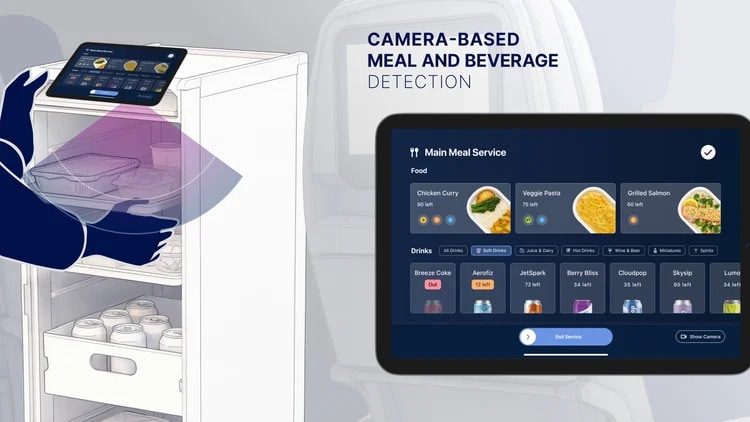
Airbus' Smart Catering innovation is an artificial intelligence-driven solution that uses camera-based recognition on existing crew tablets or mobile devices to automatically track passenger meal and beverage consumption during flights. The system updates inventory in real time without requiring extra crew activity, and then analyzes route-level data to help airlines load only the amount of food and drink that is actually likely to be consumed.
Airbus' Smart Catering system addresses the estimated 3.6 million tonnes of annual cabin waste generated by the global airline industry, with between 18-20% of that waste consisting of untouched food and drink. The AI-enabled plane system has been successfully tested on Virgin Atlantic flights, including the London to New York and London to Orlando routes.
Image Credit: Airbus
AI-Driven Creator Economy Tools
Creators are adopting AI-driven tools to monetize, remix, and engage audiences with innovative, consent-driven content, enhancing creative control and revenue opportunities.
Question 1
Do you currently create any kind of content for an audience on any of the following platforms?
Select all that apply
Question 2
Have you used any AI-powered tools to create or manage content in the past 12 months?
Question 3
What impact, if any, has using AI-powered tools had on your content creation?
Select all that apply
Fruit Roll-Up–Wrapped Popsicles
Consumers are adopting Fruit Roll-Up–wrapped popsicles as a DIY viral treat inspired by TikTok for a fun, customizable, and edible frozen snack experience.
Question 1
Which best describes your experience with Fruit Roll-Ups wrapped popsicles?
Question 2
What, if anything, appeals to you about Fruit Roll-Ups wrapped around popsicles or frozen treats?
Select all that apply
Question 3
Where, if anywhere, have you seen or heard about Fruit Roll-Ups wrapped around popsicles or frozen treats?
Select all that apply
Digital Detox Travel Hardware
Consumers are adopting dumbphones and single-purpose gadgets as essential travel hardware to minimize digital distractions during summer trips.
Question 1
During a summer leisure trip, have you ever left your usual smartphone behind and used only a basic phone or "dumbphone" with limited functions?
Question 2
What was the MAIN reason you used this type of device during your trip?
Question 3
On a future leisure trip, how likely would you be to leave your smartphone behind and use only a basic phone with limited functions?
Consumer Demand Drives Foldable and Multi-Screen Devices
Consumers are adopting foldable and multi-screen devices as they seek more versatile and pocketable screen options for enhanced mobility and functionality.
Question 1
Which of the following types of devices have you personally used in the past 12 months?
Select up to 8
Question 2
What are the main reasons you use or chose this type of device?
Select up to 3
Question 3
How likely would you be to choose a foldable or multi-screen device the next time you purchase a smartphone, tablet, or laptop?
Modular Growth Gear
Parents are adopting modular youth gear that is adjustable, upgradeable, and serviceable to accommodate fast-growing athletes and reduce the need for full replacement cycles.
Question 1
Do you currently have any children under 18 who participate in organized or recreational sports?
Question 2
Have you ever purchased sports gear designed to adjust as your child grows?
Question 3
When your child outgrows a piece of sports gear, how much of a problem is having to replace it?
Question 4
What bothers you MOST about replacing outgrown gear?
Question 5
How likely would you be to choose sports gear that adjusts or upgrades as your child grows the next time you buy one?
Trend Themes
AI-enabled Onboard Inventory Management — Real-time inventory updates from onboard AI create possibilities for dramatically reduced waste and more efficient provisioning across flight legs.
Computer Vision-powered Consumption Tracking — Camera-based recognition of passenger consumption enables precise measurement of unused meals, opening pathways to customizable service levels and cost-saving packaging strategies.
Route-level Demand Forecasting — Aggregated consumption data by route and cabin class supports refined demand models that can shift provisioning from static rules to dynamic, data-driven loading.
Industry Implications
Commercial Aviation — Onboard AI systems could transform airline operating margins by shrinking catering weight and waste while informing broader fuel and logistics planning.
Airline Catering Services — Caterers stand to reconfigure production and distribution models based on authenticated in-flight consumption patterns, enabling menu personalization and inventory minimization.
Sustainable Supply Chain Solutions — Validated consumption telemetry from aircraft can feed circular economy initiatives by quantifying avoidable waste and informing reusable packaging or redistribution networks.