




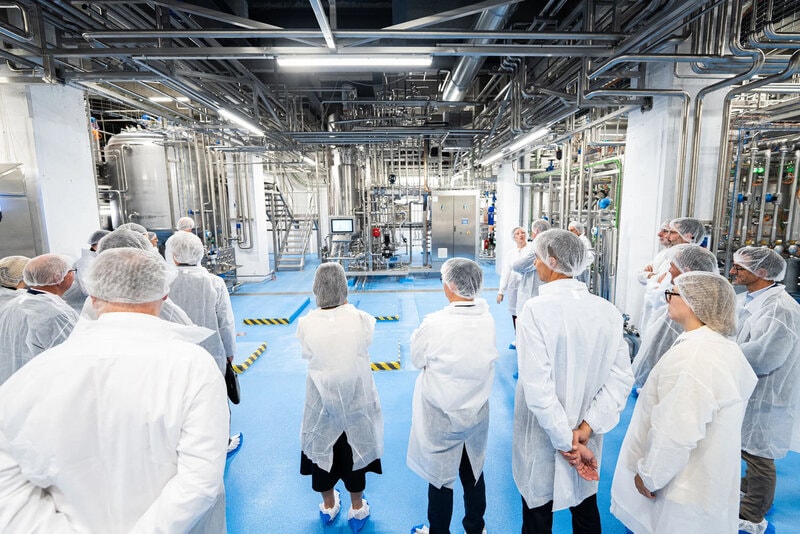



Biotech Open Platform Runs a 15-Cubic-Meter Fermentation Line
Edited by Adam Harrie — September 30, 2026 — Business
This article was written with the assistance of AI.
References: greenqueen.hk
'Biotech Open Platform' is giving fermentation companies a place to validate lab-born processes at a more realistic manufacturing scale. The France-based initiative, created by Danone, Michelin and other partners, has opened an industrial facility designed to advance fermentation work toward commercial production. It serves startups, industrial groups and R&D teams that need a bridge between bench science and factory-ready output.
Across 5,000 sq m, the site pairs a 15-cubic-meter fermentation line with semi-industrial purification, enabling users to produce enough material for application testing rather than stopping at tiny batches. That setup also lets teams refine a process and see whether it still holds up as volumes rise.
For brands, this creates a shared middle step between promising lab data and the cost of building dedicated scale-up infrastructure. Food, materials, and ingredient developers can pressure-test production sooner, potentially shortening the path to commercial output.
Image Credit: Biotech Open Platform
Across 5,000 sq m, the site pairs a 15-cubic-meter fermentation line with semi-industrial purification, enabling users to produce enough material for application testing rather than stopping at tiny batches. That setup also lets teams refine a process and see whether it still holds up as volumes rise.
For brands, this creates a shared middle step between promising lab data and the cost of building dedicated scale-up infrastructure. Food, materials, and ingredient developers can pressure-test production sooner, potentially shortening the path to commercial output.
Image Credit: Biotech Open Platform
Trend Themes
-
Shared Scale-up Infrastructure — Open-access biomanufacturing facilities reduce capital barriers for startups and corporates testing fermentation processes before committing to dedicated plants.
-
Semi-industrial Fermentation Validation — Larger pilot lines create a critical proving ground where lab-developed organisms, inputs and purification methods can be assessed under commercially relevant conditions.
-
Cross-sector Bio-platforms — Facilities serving food, materials and ingredient developers blur category boundaries and encourage faster transfer of fermentation know-how across markets.
Industry Implications
-
Biotechnology — Shared fermentation capacity expands the commercialization pathway for bio-based ventures that need validation beyond bench-scale experimentation.
-
Food and Beverage — Alternative protein, dairy and ingredient brands gain access to production environments suited to testing texture, yield and performance at meaningful volumes.
-
Advanced Materials — Bio-derived rubber, polymers and specialty materials benefit from intermediate manufacturing platforms that reveal cost, purity and scalability constraints earlier.
8.1
Score
Popularity
Activity
Freshness