



Nvidia’s RTX Pro 5500 Blackwell Delivers 84 GB Memory
Edited by Adam Harrie — September 15, 2026 — Tech
This article was written with the assistance of AI.
References: nvidia & notebookcheck.net
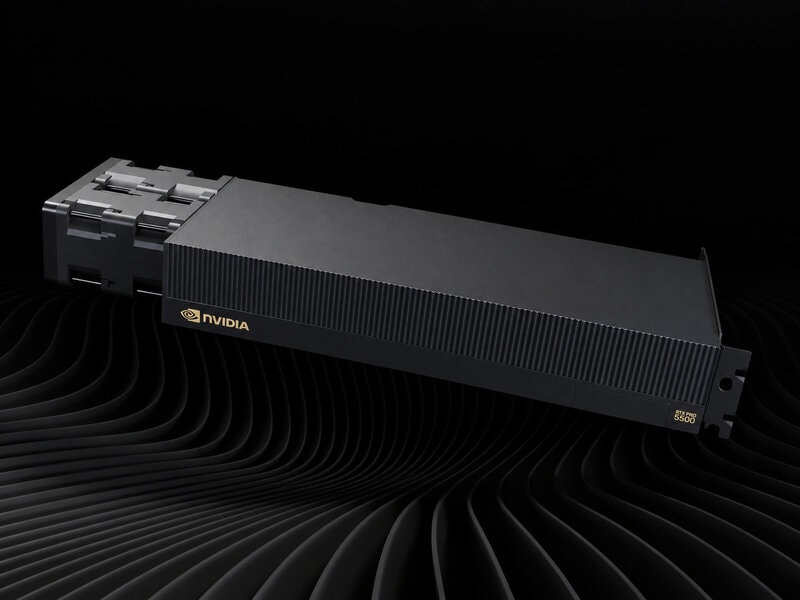
Nvidia’s RTX Pro 5500 Blackwell is a new workstation GPU with 84 GB of ECC-equipped GDDR7 memory and 21,760 CUDA cores. It sits between the RTX Pro 5000 and RTX Pro 6000 in the Blackwell lineup and is listed as coming soon, with no release date announced.
PNY lists a 750-square-millimeter Blackwell die with 92.2 billion transistors, 1,398 GB/s of memory bandwidth and a 416-bit interface. However, the reported memory capacity and bandwidth suggest the interface specification may be incorrect. The card also supports PCIe 5.0 x16, four DisplayPort 2.1b outputs, three NVENC encoders, three NVDEC decoders and MIG partitioning into one 84 GB instance or two isolated 42 GB instances.
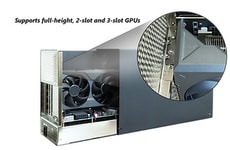
Designed for rack-mounted workstations, the two-slot card can draw up to 600 watts, with a liquid-cooled variant planned. Its large ECC memory pool reflects demand for memory-intensive AI and professional workloads, allowing Nvidia to fill the portfolio gap between its mainstream professional and flagship workstation GPUs.
Image Credit: Nvidia / RubyRapids
PNY lists a 750-square-millimeter Blackwell die with 92.2 billion transistors, 1,398 GB/s of memory bandwidth and a 416-bit interface. However, the reported memory capacity and bandwidth suggest the interface specification may be incorrect. The card also supports PCIe 5.0 x16, four DisplayPort 2.1b outputs, three NVENC encoders, three NVDEC decoders and MIG partitioning into one 84 GB instance or two isolated 42 GB instances.
Designed for rack-mounted workstations, the two-slot card can draw up to 600 watts, with a liquid-cooled variant planned. Its large ECC memory pool reflects demand for memory-intensive AI and professional workloads, allowing Nvidia to fill the portfolio gap between its mainstream professional and flagship workstation GPUs.
Image Credit: Nvidia / RubyRapids
Consumer Demand Drives Foldable and Multi-Screen Devices
Consumers are adopting foldable and multi-screen devices as they seek more versatile and pocketable screen options for enhanced mobility and functionality.
Question 1
Which of the following types of devices have you personally used in the past 12 months?
Select up to 8
Question 2
What are the main reasons you use or chose this type of device?
Select up to 3
Question 3
How likely would you be to choose a foldable or multi-screen device the next time you purchase a smartphone, tablet, or laptop?
Trend Themes
-
High-memory Workstation Gpus — Expanding onboard ECC memory enables professional users to run larger AI models, simulations and visualization workloads locally without immediately shifting to data center infrastructure.
-
Partitioned GPU Computing — MIG-enabled workstation cards create new flexibility for shared creative, engineering and AI environments by dividing one high-end GPU into isolated compute instances.
-
Liquid-cooled Workstations — Rising power demands in compact rack-mounted systems make advanced cooling a differentiator for sustaining performance in dense professional computing setups.
Industry Implications
-
Artificial Intelligence — Larger local GPU memory pools support more capable model development, inference and fine-tuning workflows for teams needing workstation-level control.
-
Professional Visualization — High-bandwidth graphics hardware improves responsiveness for complex 3D rendering, digital twins and immersive design reviews involving massive datasets.
-
Computer Hardware — Premium workstation components are reshaping product segmentation as vendors create intermediate tiers between mainstream professional cards and flagship accelerators.
4.9
Score
Popularity
Activity
Freshness