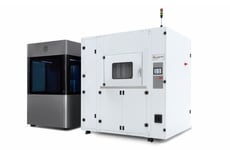




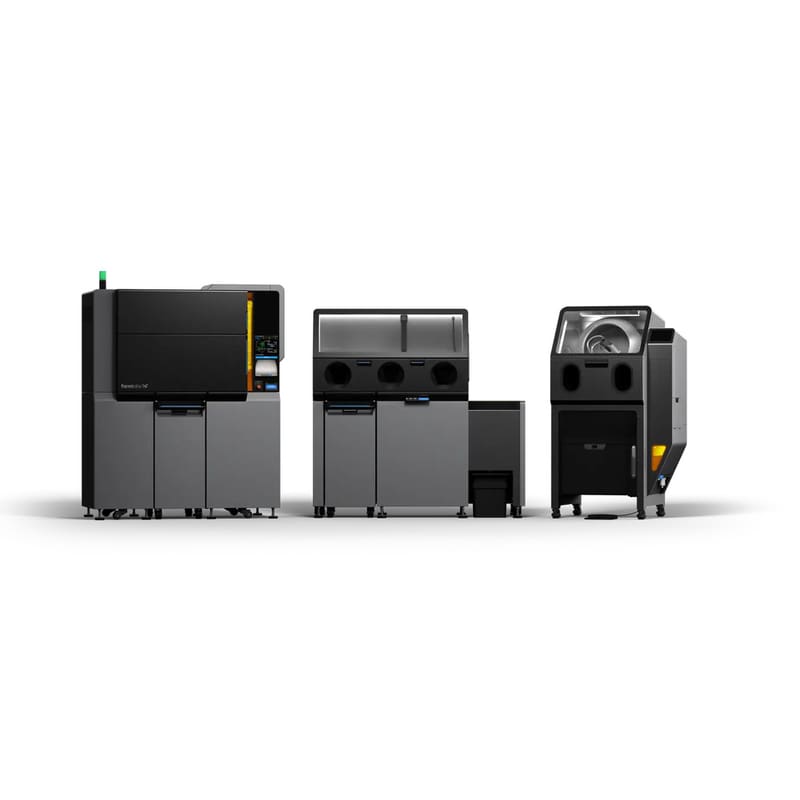



Formlabs Launches Its Fuse X1 Printer
Edited by Adam Harrie — June 18, 2026 — Business
This article was written with the assistance of AI.
References: formlabs & 3dprinting
Formlabs introduced the Fuse X1, a large-format selective laser sintering (SLS) 3D printer designed to bring industrial-scale additive manufacturing to a wider range of manufacturers. Starting at US$84,999, the system features Adaptive Thermal Control with 13 independent thermal zones and a build volume of 330 × 330 × 565 mm, enabling the production of larger parts and higher-volume builds within a compact footprint.
The Fuse X1 launches with support for Nylon 12 Powder and includes AI-powered Print Intelligence capabilities for failure detection, thermal management, motion control, systems health monitoring and optics control. Its 1.3-square-metre footprint, single-phase power requirements and rapid installation process are designed to simplify deployment compared with traditional industrial SLS systems. Additional material support, including Nylon 11, Nylon 12 GF and TPU, is planned in future updates.
For manufacturers, the Fuse X1 aims to increase throughput and reduce production costs through higher packing densities and faster build cycles, helping make production-scale 3D printing more practical for prototyping, tooling and short-run manufacturing.
Image Credit: Formlabs
The Fuse X1 launches with support for Nylon 12 Powder and includes AI-powered Print Intelligence capabilities for failure detection, thermal management, motion control, systems health monitoring and optics control. Its 1.3-square-metre footprint, single-phase power requirements and rapid installation process are designed to simplify deployment compared with traditional industrial SLS systems. Additional material support, including Nylon 11, Nylon 12 GF and TPU, is planned in future updates.
For manufacturers, the Fuse X1 aims to increase throughput and reduce production costs through higher packing densities and faster build cycles, helping make production-scale 3D printing more practical for prototyping, tooling and short-run manufacturing.
Image Credit: Formlabs
AI-Driven Creator Economy Tools
Creators are adopting AI-driven tools to monetize, remix, and engage audiences with innovative, consent-driven content, enhancing creative control and revenue opportunities.
Question 1
Do you currently create any kind of content for an audience on any of the following platforms?
Select all that apply
Question 2
Have you used any AI-powered tools to create or manage content in the past 12 months?
Question 3
What impact, if any, has using AI-powered tools had on your content creation?
Select all that apply
Trend Themes
-
Accessible Industrial SLS — Lower-cost large-format SLS systems are narrowing the gap between desktop prototyping and factory-grade production, creating new potential for smaller manufacturers to localize high-quality part fabrication.
-
AI-assisted Additive Manufacturing — Embedded print intelligence is making failure detection, thermal control and machine health monitoring more autonomous, reducing the operational expertise traditionally required for production-scale 3D printing.
-
Compact Production Cells — Smaller-footprint industrial printers with simplified power and installation requirements are reshaping how factories integrate additive manufacturing into existing workflows without major infrastructure changes.
Industry Implications
-
Manufacturing — Industrial producers gain more flexible pathways for short-run parts, tooling and end-use components as large-format SLS systems reduce cost barriers and improve throughput.
-
Product Design — Design teams can move from functional prototyping to low-volume production in the same material ecosystem, compressing iteration cycles and enabling more complex geometries.
-
Supply Chain — Distributed additive production supports more resilient inventory models by shifting select components from centralized sourcing to on-demand regional fabrication.
8.9
Score
Popularity
Activity
Freshness